


Visit our website for more information
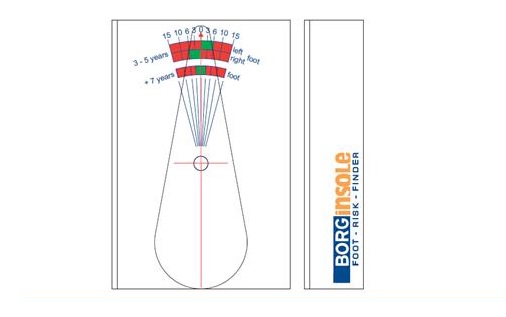
The Foot-Risk-Finder (FRF) is a clinical measuring device that is placed behind the loaded heel to objectify the position of the calcaneum quickly and reproducibly, without the need to determine a bisector.
The teardrop shape guides the recognition and positioning of the calcaneum, so that both RCSP (Relaxed Calcaneal Stance Position) and NCSP (Neutral Calcaneal Stance Position) can be efficiently assessed/measured.
The device is designed in such a way that it remains upright independently, so that the examiner has both hands free to better determine the NCSP viapalpation and at the same time to make a broader observationofthe foot, lower leg and overall posture from a distance from the patient.
The FRF can be used for children and adults.
For growing children, the FRF offers a practical way to follow the verticalization of the calcaneum and to objectify the evolutionary nature of the stance, typically in the development of 2 to 7 years.
The age indication formula (age × 2 − 14) is not an absolute standard and does not serve to scientifically define "normal" versus "abnormal" as a fixed limit.
It is intended as an informative growth direction: a tool to visualize the expected evolution towards a more vertical calcaneal position.
The name Foot-Risk-Finder emphasizes the goal: to detect extreme abnormalities and, as an accessible screening tool, to support the decision whether additional advice by a podiatrist is appropriate, especially for non-podiatrists.
In practical terms, this means: a clear abnormality that does not fit with the age-related growth direction (e.g. pronounced "positive" OCD values at a young age) is a signal to refer for podiatric examination in a timely manner.
The device can be used by the therapist / podiatrist to measure; as well as by non-professionals to objectify a possible risk for referral. Referral does not necessarily mean that treatment is needed.
 FOOTRISKFINDERNL_7140758.pdf